Generic selectors
Exact matches only
Search in title
Search in content
Post Type Selectors

Level up your fitness journey with MuscleBlaze

MUSCLEBLAZE

How Screen Time Before Bed Impacts Recovery

Hello Ziddis! We have heard from more and enough people about how screens in bed are a bad idea. Not just because it strains your eyes, but for many known and unknown reasons. Tons of research have been done on this. This blog will take notes from that research so that you know how screen time before bed is doing more harm than you estimate.

Screen Time Before Bed

Scrolling late at night, chatting, or binge-watching keeps your brain in the “day mode”. Bedtime is for powering down, but bright screens and mental stimulation from the content can delay the natural order of your body when it needs recovery. Here’s how you push recovery away when using screens during bedtime:

  • Procrastinating your bedtime
  • Increasing nighttime awakenings
  • Hamper deep sleep pattern
  • You sleep, but you don’t recover

    Blue Light and Sleep

    Blue light is a short-wavelength light from your phones, laptops, TVs, basically screens, and it resembles daylight. Your brain thinks of it as a signal to stay alert, no matter how sleepy you are or how tired your body feels. This confuses your circadian rhythm, which controls your:

    • Sleep-wake timing
    • Hormone release
    • Body temperature
    • Muscle repair and energy restoration

      Blue Light Melatonin Suppression

      Melatonin is your body’s sleep hormone. It doesn’t knock you out like pills. It sets the tone for quality sleep.

      Here is how blue light suppresses melatonin production

      • Reduce its production by sending wrong signals to the system
      • Delay its release by 30 to 90 minutes
      • Stand in its way of making you fall asleep

        What does less melatonin mean for you?

        • Longer time to fall asleep
        • Lighter sleep
        • Poorer recovery

          Sleep Quality vs Sleep Duration

          You can sleep 8 hours and still wake exhausted. Why is that so? It is because recovery depends more on sleep quality than just duration. Screens before bed can lead to disruption in sleep quality, which can not be fixed by increasing your sleep duration.

          • It reduces deep sleep, which is necessary for physical recovery and muscle repair
          • Disrupts REM sleep, which is responsible for mood, memory and emotional regulation.
          • Increases micro-awakenings

            Practical Ways to Protect Recovery

            Practical Ways to Protect Recovery

            You don’t have to go fully off-grid, but just strategic to not let screens derail your recovery.

            • Create a device-free wind-down for 30 to 60 minutes every day
            • Use light filters
            • Time your screen detox an hour before bed
            • Use an alarm instead of your phone

              Read Also: Why Sleep Quality Matters More Than Sleep Hours

              Takeaway

              Screen time before bed is common, but does not need to be normalised. It doesn’t just affect your sleep but also your recovery. Protecting your recovery is necessary for a good fitness routine. Improve your sleep quality, melatonin regulation and energy by thinking of nighttime routine as your recovery plan and not just an optional downtime. Sometimes, imbalanced vitamin levels can also prompt issues in the sleep cycle. Try vitamin supplements to fix it. Omega-3 is great to help with sleep, so adding omega-3 capsules might be a good idea. Please consult a doctor before starting it. 

              Why You Can Feel Motivated but Still Under Recovered

              Hello Ziddis! 2026 started pumped up, but it feels like a bit of us is still left in 2025, and we are lugging around with half the motivation that we were expecting to carry. Here is why you feel motivated but tired.

              Why You Feel Motivated but Tired

              Motivation is driven by dopamine, adrenaline, routine, identity and emotion. Recovery is driven by sleep, nutrition, nervous system balance, hormones and tissue repair. These can cause a bit of disconnect and confusion because:

              • Stress can masquerade as fatigue. Elevated adrenaline and cortisol from work stress, excitement or pressure can make you feel alert and driven when your body is tired.
              • Motivation is psychological momentum, while consistency, discipline or fear of losing progress can make you mentally stimulated even when you haven’t recovered yet.
              • Fitness improves tolerance before capacity.
              • The nervous system is excited but not fully recovered.

                Signs of Under-Recovery in Fitness

                A lot of signs that you experience while you are under-recovered feel like exhaustion, such as:

                • Feeling soreness that does not go away
                • Heaviness or stiffness during warm-ups
                • Declining strength or endurance despite effort
                • Slower bar speed
                • Frequent injuries
                • The same workout feels harder
                • Needing longer rest intervals
                • Poor sleep quality
                • Elevated resting heart rate
                • Reduced appetite
                • Digestion issues
                • Getting sick more often

                  Mental vs Physical Recovery

                  The conditions required for mental recovery and physical recovery are different, hence their signs are also different.

                  Mental recovery feels like:

                  • Getting excited to train
                  • Wanting routine, structure and movement
                  • Feeling a burst of energy

                    Physical recovery feels like:

                    • Nervous system calmer
                    • Hormonal balance restored
                    • Connective tissues healed
                    • Muscle growth responding
                    • More strength and fewer rest intervals

                      How to Recover Faster After Workouts

                      How to Recover Faster After Workouts

                      Studies have shown that recovery is not a passive phenomenon. It is an active choice. Here is how:

                      • Choosing sleep so that tissue repairs and the nervous system can reset
                      • Having the right food for healing muscles, like protein-rich foods, such as protein bars and protein powder
                      • Managing your stress and channelling it in workouts.

                        By training smarter, not just harder, you can recover faster after workouts

                        • Rotate intensity
                        • Avoid maxing out
                        • Deload before your body forces you to.
                        • Rest days don’t need to push you into lethargic mode. Go for walks, yoga or stretching
                        • Prioritise breathwork
                        • Reduce overstimulating elements in life

                          Preventing Overtraining and Burnout

                          The goal isn’t to kill motivation; it is to make sure it is aligned with recovery. Some strategies you can incorporate are:

                          • Use performance trends, not just feelings, to get a direction for training
                          • Treat low-output but highly driven days for higher stress training
                          • Build a routine for recovery
                          • Respect your body’s need for rest

                            Read Also: Why Recovery Days Are Non-Negotiable

                            Takeaway

                            Feeling motivated does not mean you are fully recovered. Performance pressure can be misunderstood as readiness. The best training is to train yourself to respect and understand your body better. Know when to push, when to stop and when to recover so that you can see the best output.

                            How Stress Competes With Muscle Growth

                            Hello Ziddis! We have established this in most of our blogs that while training is an important part of muscle building, muscle isn’t built during training but during recovery. Chronic stress can hamper your recovery by shifting your body into a survival state where preservation beats growth. But let us understand this in depth.

                            Muscle Hypertrophy

                            Muscle hypertrophy depends on a net positive balance between protein synthesis and protein breakdown. Strength training creates the stimulus, but growth only happens if the body decides conditions are safe enough to redirect energy into building tissues instead of putting extra effort into keeping the body safe.

                            Chronic stress tells your nervous system that it is not safe when the stress is high, and that is how:

                            • Energy is redirected towards survival functions
                            • Muscle protein breakdown increases
                            • Muscle protein synthesis becomes inefficient

                              The result of this is that you train hard, but the growth is stalled.

                              Muscle Recovery and Stress

                              When training, the stress is more physiological than psychological. This can cause:

                              • The nervous system goes into a sympathetic state of fight or flight
                              • Delay tissue repair between sessions
                              • Reduce the sleep quality, especially the deep and REM sleep stages
                              • Increase inflammation beyond useful training stress

                                Even well-programmed workouts fail, and the recovery window shrinks if you are under constant stress.

                                Muscle Growth Hormones

                                Chronic stress elevates cortisol, a catabolic hormone, which directly interferes with muscle-building processes. High cortisol can cause:

                                • Suppression of muscle protein synthesis
                                • Antagonise testosterone and IGF-1
                                • Impairs glycogen replenishment
                                • Increases amino acid breakdown from muscle tissue

                                  Growth hormones like testosterone and insulin work best when cortisol is not constantly elevated.

                                  Strength Training Recovery

                                  Strength Training Recovery

                                  Strength gains rely heavily on the nervous system. Chronic stress taxes the CNS long before muscles fail. Signs of stress limiting your recovery are:

                                  • Strength plateaus
                                  • Poor bar speed and coordination
                                  • Loss of snap or power
                                  • Needing longer warm-ups to feel normal

                                    This is why stressed lifters often feel worked but not stronger.

                                    Overtraining and Stress

                                    Overtraining is rarely just “too much training” without the right stress. Common stressors are:

                                    • Work pressure and deadlines
                                    • Emotional or relationship stress
                                    • Poor sleep consistency
                                    • Undereating or aggressive dieting
                                    • Excessive training volume without deloads
                                    • Constant stimulation through screens, caffeine and light nights.

                                      Training stress + life stress = recovery issues

                                      What can help

                                      It is not possible to stay calm always, but what can be done instead is:

                                      • Sleep consistency
                                      • Deload weeks every 4 to 8 weeks
                                      • Adequate calories
                                      • Low-intensity movement
                                      • Breathwork
                                      • Limiting high-stress inputs late during the day.

                                        Read Also: Muscle Hypertrophy: A Beginner’s Guide to Building Muscle

                                        Takeaway

                                        Muscle growth isn’t just about training harder; it is about convincing your body that it is safe to grow. Chronic stress not just hampers your mental health but also your physical health. Your muscle growth suffers if you just train hard but do not rest well. Along with the right training, adequate sleep, and good food is such as fit foods and oats protein.

                                        Why Sleep Quality Matters More Than Sleep Hours

                                        Hello Ziddis! Getting enough sleep is important, but what is more important is getting the right kind of sleep. This changes how your body recovers, adapts and performs. Eight hours of restless sleep will not be as good as six hours of restorative sleep. What matters the most is how much deep, uninterrupted sleep you get and not just how long you have been in bed. Your body doesn’t recover on a clock; it recovers in your sleep stages.

                                        Deep Sleep vs Light Sleep

                                        Sleep isn’t one uniform state. It is a cycle of stages.

                                        • Light sleep: Transition from consciousness to basic rest for limited recovery
                                        • Deep sleep: Most physically restorative stage
                                        • REM: Cognitive recovery, emotional regulation and memory consolidation happen here.

                                          Sleep needs to be deep nor fragmented. Because more time asleep but less in deep and REM sleep is not useful.

                                          Sleep Stages Importance

                                          Deep sleep is when your body does the real work, such as:

                                          • Growth hormone release peaks
                                          • Muscle tissue repairs and rebuilds
                                          • The immune system strengthens
                                          • Nervous system downshifts into true recovery
                                          • Insulin sensitivity improves

                                            REM sleep helps support more complex functions such as:

                                            • Learning and skill retention
                                            • Mood stability
                                            • Stress processing

                                              Now imagine, with a poor sleep quality, your body is missing out on regulating so many functions.

                                              Benefits of Deep Sleep

                                              High-quality deep sleep directly supports:

                                              • Faster muscle repair and strength gains
                                              • Better fat metabolism and hormone balance
                                              • Reduced injury risk
                                              • Improved energy and training performance
                                              • Lower cortisol and inflammation
                                              • Sharper focus and emotional resilience

                                                This is why some people can sleep for 8 hours and yet feel exhausted because they are in light sleep, not deep sleep, and their body does not go through restorative processes.

                                                Effects of Poor Sleep Quality

                                                Chronic low-quality sleep leads to:

                                                • Blunted muscle growth despite quality and long training sessions
                                                • Increased levels of stress hormone, aka cortisol
                                                • Slower recovery between workouts
                                                • Increased cravings and poor appetite regulation
                                                • Weaker immune response
                                                • Higher injury and burnout risk

                                                  Sleep Hygiene Tips

                                                  Sleep Hygiene Tips (That Actually Work)

                                                  Improving sleep quality is all about making sure you reach deep sleep sooner and experience it for longer rather than staying in bed for more hours.

                                                  Control your sleep environment:

                                                  • Dark room
                                                  • Cool temperature
                                                  • Quiet or no sudden loud noises
                                                  • Comfortable mattress and pillow

                                                  Create a winding-down ritual to signal your nervous system that the day is ending:

                                                  Be strategic with what you eat around bedtime:

                                                  • Avoid heavy meals 2-3 hours before bed
                                                  • Limit alcohol
                                                  • Cut off caffeine at least 8 hours before bedtime
                                                  • Include protein to kickstart the recovery.

                                                  Protect your circadian rhythm:

                                                  • Sleep and wake up at the same time daily (including weekends)
                                                  • Get sunlight within 30 to 60 minutes of waking
                                                  • Avoid bright screens right before sleep

                                                  Train smarter:

                                                  • Don’t work out late
                                                  • Intense workouts closer to bedtime can delay deep sleep
                                                  • Extend your cooldown and breathwork if you normally train at night.

                                                      Read Also: The Science of Sleep: How It Impacts Your Fitness Journey

                                                      Takeaway

                                                      Sleep quality beats sleep quantity every time. Your body demands deep, restorative sleep, not just lying down and calling it recovery. Deep, uninterrupted, quality sleep is where your body heals and grows, so do not compromise it. Train hard, eat well, rest enough, because that is all that matters. If 2026 is your year of taking your fitness seriously, gym supplements can help cement that resolution, especially creatine.

                                                      Why Skipping Meals Affects Training More Than You Think

                                                      Hello Ziddis! Many people skip meals to cut calories, stay lean or make up for missed workouts in a busy schedule. On paper, it adds up. You are still consuming less than you are spending. But physiologically skipping meals before workout can create a chain reaction that quietly sabotages strength, endurance, recovery and long-term progress.

                                                      Skipping Meals Before Workout

                                                      Skipping meals before a workout can directly reduce energy availability, the amount of usable energy left after basic bodily functions are met. When you train in a poorly fueled state:

                                                      • Blood glucose drops faster
                                                      • Perceived effort increases earlier
                                                      • Power output declines even at average loads.

                                                      Muscles rely heavily on glycogen, especially during resistance training and high-intensity cardio. If you skip meals, especially carbs, which are responsible for replenishing glycogen stores, the already low levels of glycogen show symptoms even before you begin.

                                                      • Faster fatigue
                                                      • Shorter effective training sessions
                                                      • Reduced ability to push load or volume

                                                      This is why when you starve yourself, your workouts feel harder and show less results.

                                                      How Missing Meals Affects Muscle Growth

                                                      Muscle growth doesn’t happen in the gym; it happens in the kitchen and in bed. Rest and nutrition are the factors that can make or break your muscle growth dreams. Skipping meals interferes with muscle building by:

                                                      • Reducing protein synthesis
                                                      • Elevating cortisol levels
                                                      • Lowering insulin response

                                                      Eventually, this can lead to a frustrating scenario where you train consistently but see little change in muscle size or tone.

                                                      Does Skipping Meals Impact Strength Training?

                                                      The short answer is yes! The longer one is, that it affects because your strength output is dependent on the readiness of your nervous system, muscle fibre recruitment and availability of fuel for high-effort training.

                                                      When you skip your meals:

                                                      • CNS fatigue accumulates faster
                                                      • Muscle fatigue starts earlier in sets
                                                      • Strength plateaus appear sooner

                                                      While you might be able to squeeze in a few more reps, the principle of progressive overload goes out the window.

                                                      Some common dialogues heard by those who skip meals are:

                                                      • I feel weak for no reason
                                                      • My warm-up weights feel heavier
                                                      • Progress is stalled even when I train hard

                                                      Meal Timing for Gym Performance

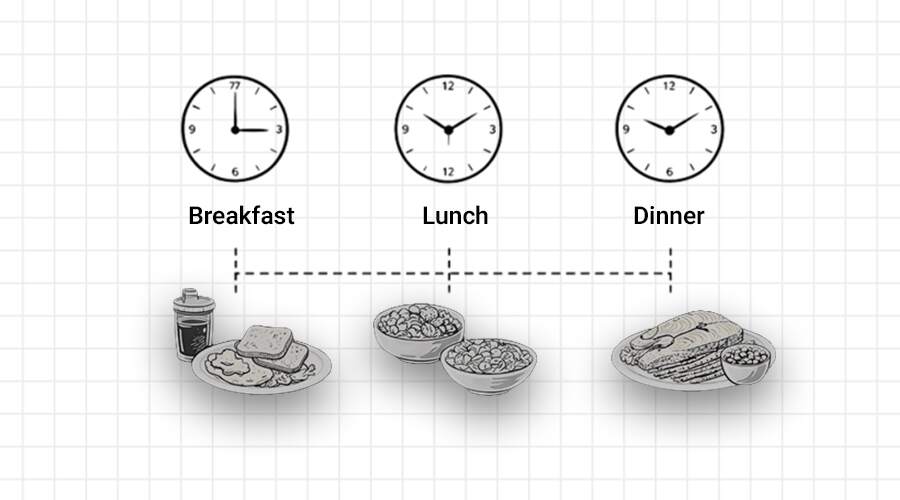
                                                      Meal timing doesn’t need to be perfect. It needs to be consistent. Here is ideally what must be followed for every meal

                                                      • Pre-workout nutrition needs to be taken 1 to 3 hours before working out
                                                      • Post-workout nutrition needs to be done within 2 hours of finishing your training to replenish lost glycogen and start recovery
                                                      • Both Lunch and Dinner are important and mustn’t be skipped. Ideally, dinner should be eaten before 9 pm to ensure you can digest your food properly.

                                                      Staying Fueled Without Overeating

                                                      Nutrition Mistakes That Hurt Training

                                                      Skipping meals rarely happens alone. This mistake can lead to more nutritional mistakes, such as:

                                                      • Relying on caffeine instead of food
                                                      • Saving calories for later
                                                      • Underestimating carbs and relying solely on protein
                                                      • Overconsuming fibres can lead to feeling gassy
                                                      • Getting into a vicious binge-eating cycle.

                                                      Staying Fueled Without Overeating

                                                      Fueling properly does not mean eating excessively. It means to eat strategically. Here are some simple tips to follow:

                                                      • Anchor meals around training times
                                                      • Have smaller meals
                                                      • Not to avoid carbs entirely
                                                      • Have proteins in every meal.

                                                      Meals don’t stall your progress; lack of energy does.

                                                      Read Also: Winter Hydration: Why Skipping Water Could Hurt Your Workouts

                                                      Takeaway

                                                      Skipping a meal doesn’t just affect your body weight but also your body’s performance, its ability to adapt and recovery rate. Low energy availability reduces glycogen and disrupts the hormones while increasing fatigue and limiting progress. While you start your fitness journey, fitness accessories can keep you motivated, and your trusted shakers for your supplements could be a great reminder that nutrition is as important as training!

                                                      Stability Training: The Secret Behind Celebrity Bodies

                                                      Hello Ziddis! Scroll through red carpet highlights, and you would notice something really interesting. It is not that celebrities look only lean, they look balanced, controlled and athletic. That “sculpted but functional” physique is not just built by heavy lifting or endless cardio, but stability training. That is the real secret. Influencers usually call it core control, athletic flow or functional sculpting, but the foundation is the same. Training the body to move efficiently, powerfully and injury-free.

                                                      Stability Training

                                                      Stability training focuses on strengthening the muscles that control and support movement, rather than just producing force. These include deep core muscles, hip stabilisers, scapular muscles and the small muscles around the joints.

                                                      Your usual isolation workouts do not challenge your body as the stability exercises challenge:

                                                      • Balance
                                                      • Coordination
                                                      • Joint control
                                                      • Neuromuscular efficiency

                                                      Some examples of stability exercises include:

                                                      • Single-leg movements
                                                      • Anti-rotation core work
                                                      • Slow tempo strength
                                                      • Controlled transitions

                                                      The goal is not just to lift weights but to own the momentum. This is why stability training builds your body that performs just as well as it looks

                                                      Celebrity Workout Secrets

                                                      Celebrity trainers are creating bodies chased by paparazzi. Here are their goals:

                                                      • Look good from every angle
                                                      • Move well on camera
                                                      • Stay injury-free under intense schedules

                                                      To achieve these goals, most A-list programs quietly prioritise stability. Some focus point workouts are:

                                                      • Single-arm presses instead of barbell benches
                                                      • Unilateral leg work instead of heavy bilateral lifts
                                                      • Slow eccentric phases
                                                      • Core engagement in nearly every exercise

                                                      The result of this is muscles that appear tighter, a posture that looks effortless and movement that feels more elegant.

                                                      Functional Training

                                                      Stability training is a cornerstone of functional training because in real life and on the red carpet, they aren’t symmetrical.

                                                      Functional workouts train the body to:

                                                      • Transfer force between limbs
                                                      • Control rotation
                                                      • Decelerate safely
                                                      • Maintain alignment under fatigue

                                                      This is why functional training creates physiques that look athletic rather than bulky. Muscles are trained to cooperate instead of dominate. A stable body distributes tension evenly, which prevents the overdeveloped areas and undertrained joints that often lead to pain or stiffness.

                                                      Hollywood Fitness Routines

                                                      Whether an actor is preparing for a superhero role or a romantic drama, Hollywood routines often follow a similar structure:

                                                      • Activation and stability work for the core, hips and shoulders.
                                                      • Compounds movements with instability elements
                                                      • Low-volume, high-quality strength work
                                                      • Mobility and recovery are built into sessions.

                                                      Tools like sliders, cables, resistance bands, suspension trainers and even bodyweight are way more useful than people realise.

                                                      Athletic Training for Actors

                                                      Athletic Training for Actors

                                                      Actors train like athletes because they need to alter their body type multiple times in a short period. This puts them under pressure, hence stability training is important because:

                                                      • Changes direction smoothly
                                                      • Absorb impact safely
                                                      • Maintain posture during long shoots
                                                      • Reduce injury risk

                                                      This is why you see more emphasis on

                                                      • Anti-rotation core drills
                                                      • Single-leg strength
                                                      • Scapular stability
                                                      • Controlled tempo training

                                                      Read Also: Steady-State vs. HIIT: What Works Better for Fat Loss & Athletic Performance?

                                                      Takeaway

                                                      Celebrity bodies aren’t built by chasing aesthetics alone; they are built by mastering control before intensity. Stability training helps in improving your muscle definition and making you look effortlessly fit. So enter your main character era with a well-planned workout regimen and quality fitness accessories like a functional duffle bag and shakers for your best supplements.